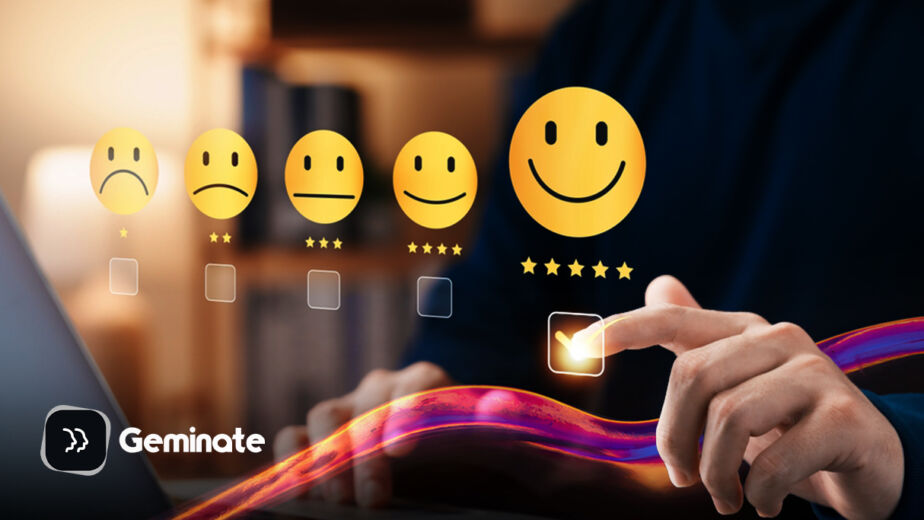
In 2026, customers don’t want to “be delighted.” They want to be understood—fast. The brands winning right now aren’t the ones with the loudest ads or the prettiest apps. They’re the ones that can recognize intent in real time, respond in the right tone, and actually finish the job without bouncing people through five systems and three departments.
At Geminate AI, we build AI systems that do exactly that: brand-trained, multilingual AI agents that can handle conversations and workflows across channels—then learn from what happens next.
So let’s talk about what personalized customer experience really looks like in 2026, what’s powering it, and how to do it without turning your business into a Frankenstein stack of tools.
Personalization in 2026 isn’t “Hi, {FirstName}”
Old personalization was basically a mail merge with better fonts. New personalization is context + timing + action.
A truly personalized experience in 2026 means your customer can:
-
- message you on WhatsApp, email, chat, or voice
- get an answer that matches your brand voice
- and have the request resolved (not “escalated”) because the system can actually do something about it
The shift is simple: AI doesn’t just talk anymore. It executes.
The engine: real-time context, not static profiles
Personalization only works when your AI understands what’s happening right now—not what happened three purchases ago.
Modern AI personalization is powered by:
-
- Live customer signals (messages, bookings, browsing behavior, service history)
-
- Unified business context (policies, inventory, pricing rules, SLAs, workflows)
-
- Clean integrations into CRMs, internal dashboards, and cloud tools
When those pieces connect, your customer doesn’t have to repeat themselves—because your system already knows what’s relevant.
The real breakthrough: agentic AI that finishes the workflow
Most “AI customer experience” still gets stuck at conversation. It can explain your refund policy beautifully… and then ask a human to process the refund.
In 2026, the real personalization advantage comes from agentic automation:
-
- an AI agent replies in-brand
-
- routes the request correctly
-
- updates systems
-
- books, reschedules, refunds, tags, logs, escalates only when needed
-
- and closes the loop with the customer
That’s why we focus on autonomous AI systems that make decisions and complete workflows, not just chat.
Omnichannel is the default—and tone is part of the product
Customers don’t experience your company as departments. They experience you as a single conversation that moves across channels.
In practice, that means your AI has to:
-
- keep continuity across WhatsApp, email, web chat, and voice
-
- respond in the same personality every time
-
- follow your rules (refund windows, booking policies, escalation boundaries)
We call this brand-trained AI—your tone, your voice, your policies, applied consistently at scale.
Multilingual personalization isn’t a “feature”—it’s a conversion lever
In 2026, “We only support English” is a revenue leak.
Multilingual, brand-aware AI changes the game because it lets you:
-
- respond instantly in the customer’s language
-
- keep your brand tone intact
-
- avoid the awkward “translated but not really” vibe
And when customers feel understood, they buy more, complain less, and churn slower. That’s not fluff. That’s behavior.
Predictive personalization: the best experiences start before the customer asks
The highest-performing customer experiences now run on anticipation:
-
- spotting churn risk early
-
- flagging repeat issues
-
- predicting booking conflicts
-
- triggering proactive updates (“Your order is delayed—here’s the new ETA and a credit applied automatically.”)
This is where personalization stops being reactive and becomes strategic. And yes—done right, it reduces tickets while improving satisfaction. Win-win, the rare kind.
Measurement matters: personalization without visibility is just chaos
If you can’t measure it, you can’t improve it—and you definitely can’t trust it.
Personalized CX in 2026 is tied to dashboards that track:
-
- response speed, resolution time, escalations
-
- decision outcomes
-
- customer sentiment signals
-
- workflow efficiency and drop-offs
At Geminate, we build systems with performance dashboards and real-time analytics so teams can tune what the AI does (and prove ROI without hand-waving).
The non-negotiable: privacy-first, enterprise-grade security
Personalization requires data. Data requires trust.
That’s why security can’t be an afterthought. In our world, AI agents must be private, secure, and designed for critical business tasks, with a privacy-first approach and serious infrastructure behind it.
How to implement personalized AI customer experience without the clutter
Here’s the clean path we use with clients:
-
- Workflow analysis & opportunity mapping (find the real bottlenecks, not the loudest complaints)
-
- Design AI-based workflows that handle both conversation and execution
-
- Deploy with low-code/no-code where possible, integrate with what you already use, and iterate with real feedback
This avoids the classic mistake: buying five tools, wiring them together, and calling the mess “AI transformation.”
Quick FAQ
What’s the biggest personalization trend in 2026?
Agentic AI—systems that don’t just respond, but complete workflows end-to-end.
Does personalization mean replacing human support?
No. It means your humans stop doing copy-paste labor and start handling the exceptions that actually need judgment.
Where does personalization pay off fastest?
High-volume support, bookings/scheduling, lead follow-ups, and any process where delays kill conversion.
Ready to make customer experience feel effortless again?
Personalization in 2026 isn’t a sprinkle on top. It’s an operating system: always-on, brand-aligned, multilingual, and able to act.
That’s what we build at Geminate AI—automation at scale, without technical debt or bloated teams.